Skip to main content Skip to sitemap

Teaching in French schools abroad and preparation for the CAPEFE-1 exams

Composants du corps de la page

Attention: to register for this UE 3, the B2 level in English is mandatory

Objectives: Preparation for the CAPEFE exams organized in person, with a distance learning part in an adapted digital format, according to the following modalities in M1. The UE must be taken S1+ S2.

The Certificat d'aptitude à participer à l'enseignement français à l'étranger (CAPEFE) is a new certification aimed at future teachers of all disciplines who wish to teach during part of their career abroad in a multilingual context.

Catégorie
Masquer le titre de la page
0

Discovery of foreign educational systems

Composants du corps de la page

Objectives :

  • to develop knowledge and change perceptions of the teaching profession in another country
  • explore lively, if not controversial, educational issues by linking several sources: institutional databases (Eurydice, TIMSS, etc.), virtual exchanges with managers, teachers and students from other countries
  • discover the possibilities of outgoing international mobility

Catégorie
Masquer le titre de la page
0

Mindfulness Meditation and Learning 2

Composants du corps de la page

Objectives: It is desirable to have followed module 1 (in Master 1) or to have a personal practice of mindfulness
To help students (and their students in M2) benefit from the positive effects of the practice of mindfulness, both from the point of view of learning and interpersonal relationships and the individual well-being of each.
Attention, concentration, empathy, self-esteem, cooperation, emotion management, school climate, benevolence, conflict prevention

  • in training...

    Mindfulness is an expression designating an attitude of attention, presence and vigilant awareness, which can be internal (sensations, thoughts, emotions, actions, etc.) or external (to the surrounding world, sounds, objects, events, etc.).
    According to psychiatrist Christophe André, meditation "promotes a mental state that prevents stress and depression. The word consciousness is sometimes considered reductive, which is why it is also called full presence, attentive presence. It also refers to a "training of the mind".
    GPA allows us to develop attention and concentration skills, but more broadly, to understand what is going on in our bodies and thus to identify, welcome and accept our emotions.
    In class, students are more available to the present moment and thus more focused, calmer (GPA allows the calming of the mind and emotions) and also develop empathy which can translate into better cooperation and living together.
    Research also proves the benefits of GPA on the brain, since focused attention inhibits distractors.
    Teachers, by practicing GPA in the classroom, are therefore developing their own psycho-social skills as well as those of their students.


    ue3 meditation
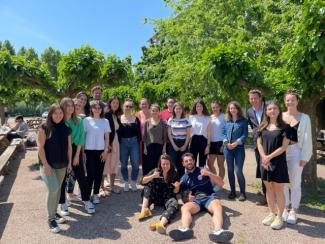
    The students of the UE 3 site of Avignon
Catégorie
Masquer le titre de la page
0

Mindfulness Meditation and Learning 1

Composants du corps de la page

Objectives: To enable students to benefit from the positive effects of the practice of mindfulness, both from the point of view of learning and interpersonal relationships and individual well-being.

Catégorie
Masquer le titre de la page
0

Develop social and emotional skills 2

Composants du corps de la page

Recommended audience:

-This course is open to all, but it is recommended for school teachers and teachers of secondary education in Arts, and HGEMC.

-Open to all but recommended for students who have completed level 1

-Training not recommended for CSRs, evaluation done in person

Key Words: Harassment, empathy, self-esteem and awareness, cooperation, conflict prevention

Presentation:
To begin, we invite you to read the presentation of the EU level 1
The UE3 develop social and emotional competences level 1 allowed to discover elements of the program of development of psychosocial competences (Prodas) and to be sensitized to harassment in school context. The objective of level 2 is to continue this discovery with a view to concrete implementation in the classroom.
The first part of the course will allow the students to remobilize or discover the essential concepts covered in level 1 (social skills, emotional skills, harassment, etc.) and to discover or rediscover some of the Prodas workshops/tools and their objectives.
In a second phase, level 2 will aim to develop reflection on the more concrete implementation of the program in the classroom by proposing to question the role of facilitator and teacher. How to implement the program in the classroom this year (Alternant, FSTG) or in the future. How to conduct the workshops? What obstacles? What links with the common base and the programs? etc...

The organization of the EU :
Approximately 2/3 of the EU's time is devoted to Prodas. The training is based on real-life situations in which students are required to experience workshops as students or as facilitators in order to analyze the issues at stake. The training thus requires a real commitment from the student(corporal, vocal...) in group work. There is an alternation between theoretical contributions, role-playing, and analysis of real-life situations. The remaining third is devoted to raising awareness about harassment in the school context.

Evaluation:
The evaluation is related to the professional development of the student in the field of social and emotional skills based on the student's commitment to the different workshops and in his ability to explain the evolution of his perception of social and emotional skills.

Catégorie
Masquer le titre de la page
0

Develop social and emotional skills 1

Composants du corps de la page

Presentation of the UE3 : DEVELOPING SOCIAL AND EMOTIONAL SKILLS level 1

Recommended audience:

-This course is open to all but is recommended for school teachers and teachers of secondary education in Arts, and HGEMC.

Not recommended for CSRs, evaluation done in person.

Key words: Harassment, empathy, self-esteem and awareness, cooperation, conflict prevention

Presentation:
Improving school climate has become a major public policy issue in education. School climate reflects the judgment of parents, educators and students about their experience of living and working in school . It thus refers to the quality of life in school. Scientific research, and in particular the OECD's international program (Pisa), proves that a school climate influences student successThe program [...] has an impact on safety in the school environmentIt has an impact on the reduction of risk behaviors, micro-violence and harassment, absenteeism and dropout (MENJS, 2022)

This course aims to provide you with knowledge related to

  • social skills (ability to understand social expectations and to adapt one's behavior to various socio-cultural contexts)
  • Emotional skills (ability to understand emotions, adapt them and moderate their expression)

It will allow you to discover a prevention program (Prodas) that aims to promote the well-being of students and prevent violence by developing psychosocial skills. This program is implemented in the Aix-Marseille academy from kindergarten to high school, and in the Montpellier academy

It will also allow you to be aware of harassment in schools (what is it? how to prevent? how to act?)

The organization of the EU :
Approximately 2/3 of the time spent on the course is devoted to the discovery of Prodas and its various workshops that allow students to develop their psychosocial skills. The training is based on real-life situations where students are brought to live these workshops to analyze the issues. The training therefore requires a real commitment from the student (body, voice...) in group work. There is an alternation between theoretical contributions, role-playing, and analysis of real-life situations. The remaining third is devoted to raising awareness about harassment in the school context.

Evaluation:
The evaluation is related to the professional development of the student in the field of social and emotional skills based on the student's commitment to the different workshops and in his ability to explain the evolution of his perception of social and emotional skills.

Catégorie
Masquer le titre de la page
0

Artistic and cultural education 2

Composants du corps de la page

Artistic and cultural education (EAC) and its course (PEAC) throughout the schooling (law of refoundation of the School of the Republic of 2013) contributes to the success and the blooming of the elèves, notably through the development of the'autonomy and creativittion, the diversification of means of'expression and the'It plays a decisive role in the fight against inequality by promoting a better understanding of the world. It plays a decisive role in the fight against inequalities by promoting a better understanding of the world around us.gal accessès of all young people to the'art and culture while respecting the freedom and initiatives of the actors involved.s.

Objective génétion of thet h e o p e r a t i o n:
Understand how the
'EAC allows for'amés process.'s learning process. élèves (reinforces the'attention, calms the climate, establishes a different posture towards adults, supports self-confidence) by enriching the professional positioning of teachers.

This module allows teachers to know the missions of the DAAC and its contribution to the PEAC.

This module will'This module is part of the generalénés general framework.éférentiel To train to the métion and educationducation au 21e siècle (2019): " Initial training aims to à to train humanists who pass on knowledge, culture and meaning ".

PrerequisitesRegistration in this module does not require any previous progress or pre-requisites.

AudienceThe module is open to all courses and specializations.

Course of study: The first step of the module is'The first stage of the module opens with a cultural encounter with different cultures.éThe first stage of the module opens with a cultural encounter in different areas of artistic culture in partnership with the DAAC (Academic Delegation for Artistic and Cultural Education): Plastic arts, cinema, theatreéma, théâart, cinema, theater, ...

Prospects for projects in mixed groups are engagedées à s experience of the school public (SOPA or in charge) and the cultural offer.s experience (SOPA or in charge) and the cultural offer.The project, from virtual to modestly expérimentThe project, from virtual to modestly experienced, will always be conditioned by the feasibility and of the cultural context (school audiences, environment environment, cultural resources).

Progression and evaluation: The project is developed gradually during the seminars. Its restitution is done in the form of'a écrit d'an oral restitution at the end of the progression.

Catégorie
Masquer le titre de la page
0

Artistic and cultural education 1

Composants du corps de la page

Artistic and cultural education (EAC) and its course (PEAC) throughout the schooling (law of refoundation of the School of the Republic of 2013) contributes to the success and the blooming of the elèves, notably through the development of the'autonomy and creativittion, the diversification of means of'expression and the'It plays a decisive role in the fight against inequality by promoting a better understanding of the world. It plays a decisive role in the fight against inequalities by promoting a better understanding of the world around us.gal accessès of all young people to the'art and culture while respecting the freedom and initiatives of the actors involved.s.

Objective génétion of thet h e o p e r a t i o n:
Understand how the
'EAC allows for'amés process.'s learning process. élèves (reinforces the'attention, calms the climate, establishes a different posture towards adults, supports self-confidence) by enriching the professional positioning of teachers.

This module allows teachers to know the missions of the DAAC and its contribution to the PEAC.

This module will'This module is part of the generalénés general framework.éférentiel To train to the métion and educationducation au 21e siècle (2019): " Initial training aims to à to train humanists who pass on knowledge, culture and meaning ".

PrerequisitesRegistration in this module does not require any previous progress or pre-requisites.

AudienceThe module is open to all courses and specializations.

Course of study: The first step of the module is'The first stage of the module opens with a cultural encounter with different cultures.éThe first stage of the module opens with a cultural encounter in different areas of artistic culture in partnership with the DAAC (Academic Delegation for Artistic and Cultural Education): Plastic arts, cinema, theatreéma, théâart, cinema, theater, ...

Prospects for projects in mixed groups are engagedées à s experience of the school public (SOPA or in charge) and the cultural offer.s experience (SOPA or in charge) and the cultural offer.The project, from virtual to modestly expérimentThe project, from virtual to modestly experienced, will always be conditioned by the feasibility and of the cultural context (school audiences, environment environment, cultural resources).

Progression and evaluation: The project is developed gradually during the seminars. Its restitution is done in the form of'a écrit d'an oral restitution at the end of the progression.

Catégorie
Masquer le titre de la page
0

Artistic creativity in multilingual education 2

Composants du corps de la page

Objective of the module To learn how to design interdisciplinary projects based on artistic expression (theater, music, creative writing, slam, dance, visual arts, etc.), in order to expand one's teaching practice. To develop creativity as a cross-curricular professional skill for teachers and as a learning potential for students.

DescriptionThis UE3 module is intended for all students of mentions 1 and 2, whatever the discipline, who are interested in the notions of interdisciplinarity, project-based pedagogy, inclusive schooling and so-called "sensitive" approaches in education (development of emotional skills, empathy and creativity in the learner: that is to say, transversal skills, called psycho-social skills).

This module will invite you to learn how to design interdisciplinary projects based on the so-called "performative" approach, which is well known internationally but still little practiced in France. This approach is based on the characteristics of performance art (theater, music, creative writing, dance, visual arts, etc., depending on your practices and interests) to create an interdisciplinary project. - depending on your practices and interests) to teach the disciplines. The teachers and artists involved will offer you the opportunity to experience these projects, so that you can then implement them in the classroom. In addition to the content, this course is about learning through theater how to position yourself in space as a teacher, how to place your voice, and how to use your body as a primary teaching tool.

The multilingual classes are enriched by theoretical and didactic contributions based on studies on "embodied cognition". These teach us that it is important not to separate the intellect from the learner's body, and to place the quality of the educational relationship at the heart of any teaching device. We will also see how to develop group cohesion in order to enrich interactions while taking into account each individual, his rhythm, his cognitive profile, his languages - in order to accompany him to open up to himself and to the world while carrying out his learning. The languages of the school and those of the learners will find their place in this research-field-training articulation.

The evaluation will be creative and based on these teachings and will allow you to express yourself, to make didactic choices by justifying them with theoretical contributions. Comfortable clothing is recommended.


Catégorie
Masquer le titre de la page
0

Learning to rescue at school

Composants du corps de la page

Objectives: Acquire the basics in occupational risk prevention

- Module "Introduction to occupational risk prevention
- Module "Understanding the links between work and health
- Module "Understanding the work accident".
- Module "Participate in the evaluation of professional risks".

Catégorie
Masquer le titre de la page
0
Subscribe to Training courses